COMPSCI535 - An Alternative Proof of the Price of Anarchy for Selfish Routing
In Lecture 1, we went over the classic proof that the price of anarchy for selfish routing in networks with linear latency functions is exactly \(4/3\). The original proof was due to RT02. In this post, we will discuss a simple and alternative proof from CSS08.
We first recall the basic notation:
Each edge \(e\) in the network has a linear latency function \(C_e(x)=a_ex+b_e\). Assume \(a_e\geq 0,b_e\geq 0\).
For a flow \(f\), let \(f_P\) denote the amount of traffic that use path \(P\), and \(f_e=\sum_{P\ni e}f_P\) denote the total traffic that use edge \(e\). Then the total cost is \[ C(f)=\sum_{P}f_P\cdot \sum_{e\in P}C_e(f_e) = \sum_{e\in E}f_e\cdot C_e(f_e)=\sum_{e\in E}(a_ef_e^2+b_ef_e) \] Here we actually demonstrate two ways to calculate the total cost: either by summing over the cost of each path, or summing over the cost of each edge. This equivalence will become useful later.
An Alternative Interpretation of the Proof in Class
The proof of CSS08 approaches the problem from another angle, and in fact the proof in class can also be interpreted in that way.
An Alternative Angle
Let \(\hat f\) be the flow at Nash equilibrium, and \(f^*\) be the social optimum flow (in fact, the proof does not necessarily require \(f^*\) to be socially optimal, it can be any valid flow).
By the definition of Nash equilibrium, there exists \(\lambda\) such that
- for any path \(P\) with \(\hat f_P>0\), we have \(\sum_{e\in P}C_e(\hat f_e) = \lambda\);
- for any path \(P\), we have \(\sum_{e\in P}C_e(\hat f_e)\geq \lambda\).
Therefore, consider evaluating the total cost of \(f^*\) assuming that the cost of each edge is frozen at \(\hat f\): \[ \sum_{P}f^*_P\cdot \sum_{e\in P}C_e(\hat f_e) \geq \sum_P f^*_P\cdot \lambda = \lambda = \sum_{P}\hat f_P\cdot \lambda = \sum_{P}\hat f_P\cdot \sum_{e\in P}C_e(\hat f_e) ~. \] Next, rewrite the left hand side as a sum over edge costs: \[ C(\hat f) = \sum_{P}\hat f_P\cdot \sum_{e\in P}C_e(\hat f_e) \leq \sum_{P}f^*_P\cdot \sum_{e\in P}C_e(\hat f_e) = \sum_{e\in E}f^*_e\cdot C_e(\hat f_e) ~. \] Finally, extract \(C(f^*)\) from the right hand side: \[ \begin{aligned} C(\hat f)\leq &~\sum_{e\in E}f_e^*\cdot C_e(\hat f_e)\\ = &~ \sum_{e\in E}f_e^*\cdot C_e(f^*_e) + \sum_{e\in E}f_e^*\cdot (C_e(\hat f_e)-C_e(f_e^*)) \\ = &~ C(f^*)+\sum_{e\in E}f_e^*\cdot (C_e(\hat f_e)-C_e(f_e^*)) ~. \end{aligned} \tag{1} \] So it remains to upper bound \(\sum_{e\in E}f_e^*\cdot (C_e(\hat f_e)-C_e(f_e^*))\). We will show that it is at most \(\dfrac{1}{4}C(\hat f)\), then plugging it back to (1) implies \(C(\hat f)\leq \dfrac{4}{3}C(f^*)\), which implies that the PoA is at most \(\dfrac{4}{3}\).
Proof of \(\sum_{e\in E}f_e^*\cdot (C_e(\hat f_e)-C_e(f_e^*))\leq\dfrac{1}{4}C(\hat f)\).
If you are already familiar with the proof in class, you will find that it is essentially proving the same thing. Every line of the proof below has a counterpart in the lecture notes, they are just reorganized in a different logic flow.
First, let \(H_e(x)=x\cdot C_e(x) = a_ex^2+b_e x\), which is convex and differentiable. Take the derivative at \(x=\hat f_e\), \[ H_e'(\hat f_e) = 2a_e\hat f_e + b_e ~. \] Therefore \(H'_e(\hat f_e/2)=a_e\hat f_e+b_e = C_e(\hat f_e)\). Then by the standard consequence of convexity, we have \[ H_e(f^*_e) \geq H_e(\hat f_e/2) + H_e'(\hat f_e/2)\cdot (f_e^*-\hat f_e/2) = H_e(\hat f_e/2) + C_e(\hat f_e)\cdot (f_e^*-\hat f_e/2)~. \] Rearranging terms, \[ f_e^*\cdot (C_e(\hat f_e)-C_e(f_e^*)) = f_e^*\cdot C_e(\hat f_e) - H_e(f^*_e) \leq \frac{\hat f_e}{2}C_e(\hat f_e) - H_e(\hat f_e/2) ~. \tag{2} \] Now expand the right hand side by definition, \[ \frac{1}{2}\hat f_e\cdot C_e(\hat f_e) - H_e(\hat f_e/2) = \frac{1}{2}(a_e\hat f_e^2+b_e\hat f_e) - \left(\frac{1}{4}a_e\hat f_e^2 + \frac{1}{2}b_e\hat f_e\right) = \frac{1}{4}a_e\hat f_e^2 \leq \frac{1}{4}\hat f_e\cdot C_e(\hat f_e) ~.\tag{3} \] Finally, combining (2), (3) and summing over all edges, \[ \sum_{e\in E}f_e^*\cdot (C_e(\hat f_e)-C_e(f_e^*)) \leq \frac{1}{4}\sum_{e\in E}\hat f_e\cdot C_e(\hat f_e) = \frac{1}{4}C(\hat f) ~. \] This completes the proof.
A Simple Proof by Picture
If you are feeling uncomfortable with derivatives or convex functions, no worries. Next we give an alternative geometric proof of the inequality \[ f_e^*\cdot (C_e(\hat f_e)-C_e(f_e^*))\leq\dfrac{1}{4}\hat f_e\cdot C_e(\hat f_e) ~, \] which can be illustrated by a single picture. This elegant idea is from CSS08. Note that we only consider the case where \(C_e(\hat f_e)-C_e(f^*_e)\geq 0\) (which also implies \(\hat f_e\geq f_e^*\)), otherwise the left hand side is negative and the inequality holds trivially.
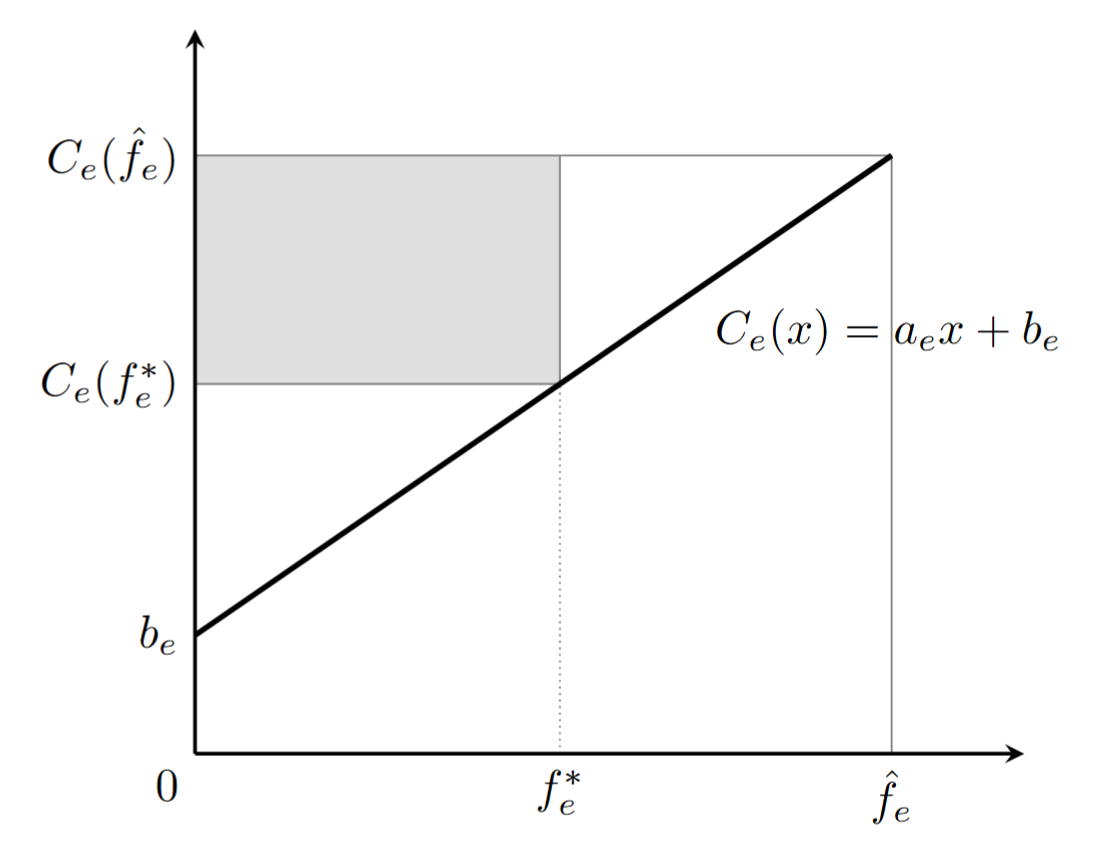
In the picture, the bold line corresponds to the latency function \(C_e(x)=a_ex+b_e\). The large rectangle has width \(\hat f_e\) and height \(C_e(\hat f_e)\), so its area is \(\hat f_e\cdot C_e(\hat f_e)\). The small shaded rectangle has width \(f_e^*\) and height \(C_e(\hat f_e)-C_e(f_e^*)\), so its area is \(f_e^*\cdot (C_e(\hat f_e)-C_e(f_e^*))\).
It remains to show that the small rectangle has area at most \(\dfrac{1}{4}\) times that of the large rectangle. Since \(b_e\geq 0\), the upper left triangle above the line \(a_ex+b_e\) has area at most \(\dfrac{1}{2}\) times that of the large rectangle. Next, any axis-aligned rectangle whose upper left vertex is at \((0,C_e(\hat f_e))\) and whose lower right vertex is on the line \(a_ex+b_e\), has area at most \(\frac{1}{2}\) times that of the triangle. This is intuitive and can be proved in various elementary ways, and is left as a simple exercise.
Reference
- [RT02] Tim Roughgarden and Éva Tardos. How Bad is Selfish Routing?. Journal of the ACM, 49(2):236–259, 2002.
- [CSS08] José R. Correa, Andreas S. Schulz, and Nicolás E. Stier-Moses. A Geometric Approach to the Price of Anarchy in Nonatomic Congestion Games. Games and Economic Behavior, 64(2):457–469, 2008.
Comments